Thursday, 8 August 2013

Only God Forgives

Man, people aren't really digging Only God Forgives. It's currently sitting at 37 on Metacritic, and critics are calling it long, boring, vulgar, misogynistic, cruel, vicious and overly violent. You know, all the things that Drive was. But I'm going to play the snobby hipster who's almost always wrong and say that they didn't get it. Here's the thing: Drive hid all of the aforementioned within a classic Hollywood story and a European arthouse aesthetic that got all the critics nostalgic and googly-eyed. So Nicolas Winding Refn decided to see how much they loved it. How much they were willing to experience. He pulled a Hangover Part Two. I love Nicolas Winding Refn. I hold Bronson, Valhalla Rising, Drive and now Only God Forgives as some of the most unique, gorgeous and entertaining movies I've seen in recent years. What I find even more entertaining is watching a director with Hollywood at his fingertips dovetail his career just so he can tell them to go fuck themselves. Cheers, Nic, you're a top bloke.


Only God Forgives is arguably even more bare bones than Drive was. Julian (Ryan Gosling) runs a boxing club in Bangkok that doubles as a drug dealing operation. His partner in crime and brother, Billy (Tom Burke), gets a bit jippy one night and hits the town looking for an underage girl to rape. He eventually finds a willing participant in a brothel owner, who brings his daughter in. Billy ends up deciding rape wasn't all he was feeling, and savagely murders her. The police are brought in, and the sergeant, Chang (Vithaya Pansringarm), brings the girl's father to the scene of the crime and leaves him alone with Billy, offering him the chance to do what he feels is right. The father beats Billy to death, and Chang takes the father's hands as punishment. Meanwhile, Julian and Billy's mother, Crystal (Kristin Scott Thomas), flies in and demands that Julian take appropriate revenge for the family. He gets the handless dad in a room, but after hearing the man claim that he was forced to kill Billy by the "Angel of Vengeance", he's unable to do the deed. Not long after, Chang's involvement becomes apparent to Crystal and all hell breaks loose as she takes increasingly violent means to see someone, anyone, die for the death of her son. Just a nice little trip to the movies, right?


But it's not this unrelentingly disgusting and vulgar just for shits and giggles. Instead, it serves to both cover and accentuate the themes underpinning this film. At it's heart, this movie is about spiritual honour; what it means to be wholly and unquestionably responsible for something (in Julian's case, family, and in Chang's case, humanity) and the deeper understanding of life and existence that such a level of thinking can provide. Early on, the film establishes the concept that though we view the film largely from Julian's point of view, we're not necessarily always operating within reality. Just following Billy's death, Julian is walking down a narrow, neon-red corridor towards a pitch-black doorway. He's clearly fearful of what exists in the dark, but he's compelled forward anyway. As he arrives at the doorway, he slowly reaches his hand into the void. Chang emerges from the darkness, sword held high above his head, and swings it down, severing Julian's hand. In the following scene, his hand is back on his body. At another point, Julian sits in a club, admiring a prostitute on stage, dancing. He imagines putting his fingers in her, but becomes irritated when men further down the table are ogling her as well. He calmly walks towards them, and as one of the men raises a glass to his mouth, he slaps it into his face. Bleeding profusely, he drags the man into the hallway by his upper jaw. Halfway down, we cut back to Julian on the chair. This was merely what he wanted to do, and as he stares at the dancer, his gaze eventually moves down to his hands stretched out in front of him.


Julian is obsessed with his hands, in these visions and in reality, because he knows that by the end of the film, he will lose them to Chang as judgement for the crimes of his family. What affords him this understanding is the honour that he operates with. From the beginning of the movie, he knows that he will lose his hands, but he does not know why. When he meets Chang, he understands: he is in the presence of God. This isn't exactly revelatory for him, nor does it change his actions from then on: once again, from the beginning, he operates almost mechanically, because he knows that whatever he's done, does or will do has been predetermined. And make no mistake: Chang is God; an all-powerful, all-knowing judge, juror and executioner that commands as much adoration, respect and fear from his colleagues as he does anyone who comes to be beneath his blade. When Julian asks if Chang would like to fight him, he knows that he is about to receive the beating of a lifetime, but that doesn't matter: this is God's will, and he is powerless to fight it. In operating with honour, he shall die with honour, which, within his shitty existence, is the best he can hope for.


What threatens his honour most throughout the film is his mother. Kristin Scott Thomas does an unbelievably disgusting and brilliant job as Crystal; never have I heard someone bring this much weight to a phrase like, "And how many cocks can you entertain with that cute little cum dumpster of yours?" She paints the picture of a mother connected and disconnected to her children in all of the wrong ways. An incestuous relationship with Billy is hinted at; which sheds a bit of light at both his actions at the beginning of the film and what he says to Julian before doing so. "It's time to meet the devil," he mumbles, because there's no way Satan can be as bad as her. She demeans, insults, berates and belittles Julian at every turn, but when the prostitute he disguised as his date for a dinner with her has the nerve to suggest she's a little unbalanced, Julian violently defends her honour. There's that word again; Julian wishes she wasn't his mother, but that does not excuse his responsibility to her. Later in the movie, Chang passes judgement on Crystal and stabs her in the throat. Julian comes across her body, cuts open her stomach and puts his hands inside her, to see what she was made of; to see if there was any shred of a mother in there.


What I love most about this movie is that I could be completely wrong in my interpretation. It's so refreshing to watch a film that assumes its audience has the intelligence to connect their own dots. Only God Forgives is an intentionally ambiguous, gorgeously filmed piece of art that I loved every minute of. But I'd be a fool to think it's something everyone should enjoy. Despite being shorter than Drive, it feels immeasurably longer. The film operates like some sort of sedated fever dream, with a pulsing, hypnotic aesthetic that's almost sleep-inducing. It helped that I was a little bit drunk when I watched it. In describing its scenes, I know for some people the movie will sound like an utterly disgusting, reprehensible piece of shit, and I wouldn't be one to do anything but respect their opinion and respectfully disagree with them. There are movies that present their answers upfront. There are movies that try and whip a little bit of symbolism in there for those willing to look for it. And then there's Only God Forgives, the whacked-out junkie in the corner, who everyone would be hearing the world's greatest story from if only it wasn't pausing every three seconds to stab at the air and shout "FUCKIN' GUTTER CUNTS." I'm grateful there's people like Nicolas Winding Refn out there, but I'm even more grateful that he doesn't care if I am.

Wednesday, 31 July 2013

Pacific Rim

Let's get something out of the way real quick: I don't like anime. I like Japanese animation (quite a few of Studio Ghibli's efforts stand as some of my all-time favourite films, along with the works of Satoshi Kon and Katsuhiro Ohtomo), but that particular genre has always eluded me. I've given it a go here and there, but even growing up, I preferred playing Pokemon to watching it. I gave up on Dragon Ball Z after a character spent the length of three episodes charging an attack just to miss and start charging again. I know I may have just listed two of the most non-anime animes out there, but if anything, it should just illustrate how removed from this brand of entertainment I am. That said, there are tropes within the anime genre I like, such as gigantic human-controlled robots breaking shit. I also really like big monster movies. And nobody does big monster movies like Toho. I fucking love Godzilla, so much so I even thought the 1998 American production was unfairly treated. When I heard a movie was going to be made about big robots fighting bigger monsters and that Guillermo del Toro, one of my favourite directors, was at the helm, I was over the fucking moon. Guillermo del Toro could bring his unique visual direction and quirky sense of humour to a genre bloated with stale narratives and cookie-cutter personalities. Turns out he's just a huge fanboy when it comes to this shit, and he's gone and made the No Homers Club: a live-action Neon Genesis Evangelion for him when he was 12, the couple of buddies he has that feel the same way and nobody else. Well, on ya Guillermo, but this is probably why everyone went and saw Grown Ups 2 instead.


I'm tired of seeing iconic monuments be destroyed in long, gratuitous, almost pornographic sequences. One of the best things Pacific Rim does is respect your intelligence with its premise; it knows you've already seen the White House get stomped on fifteen times, so it skips it. The movie begins with a very lean montage explaining that monsters came out of nowhere, destroyed a bunch of stuff and we made robots to fight them back. We get very quick flashes of the world going up in flames, but the movie actually starts right in the thick of it. Perfect. The robots themselves are also kind of interesting. The gist of it is they require two people to operate due to the incredible psychological strain involved in using one. These two people are linked mentally; their memories overlap and collide, and by the end of the process they're essentially operating as one. The unique and interesting elements end there. So two brothers (the guy from Sons of Anarchy and someone you don't need to know the name of because he'll be dead in five minutes) are the pride and joy of the military oraganisation defending the world from the monsters, if it weren't for their recklessness and tendency to disobey orders. It gets one of them killed. The Green Street Hooligan retreats into industrial work while the world slowly starts losing the war with the beasties. He's called back into the game for one last job, one last stab at saving the world. I'm getting bored writing this.


The biggest problem this movie has is that smack dab in the middle, there's over an hour of character development, which wouldn't be an issue if it wasn't so fucking boring. My gripes with the tropes of anime aside, this is unbelievably bad dialogue, entirely predictable character beats and just general bad storytelling. What's worse is it's clearly intentional. Guillermo del Toro is knowingly operating within the structure and expectations of the genre he's adapting, with all of the flaws that comes with. He knows it's a joke, but he refuses to let any of the actors wink into the camera. It's like a version of Airplane where the automatic pilot is a computerised system and not a blow up doll. One of the worst examples comes towards the end of the movie. There's two "Australian" (sporting hands-down the fucking worst attempts at Australian accents I've ever heard) robot men, father and son, who have an estranged relationship. Daddy didn't love Junior enough, and it's turned him into a dick. The final stand is approaching, and Dad's busted his leg. Junior has to fight without him. "I shoulda loved ya, ya billy gum drongo," Dad slurs tearfully with a tinny in one hand as he uses the other to give Junior the hug he's always dreamed about. As Junior walks away, Dad yells to his team mate, "Be careful with him! That's my son! That's my son..." Why did that need to be repeated? It's not like Junior's the one person who can save the world. He's not even the central protagonist. Why does his relationship with his Dad even matter to the plot, especially when all it took was a cuddle to fix? At another point, Idris Elba, playing a generic General, shouts, "Today we are cancelling the apocalypse!" In a movie full of self-referential, quirky humour, this would have been incredible. But it's in this movie, so it just sucks.


It's so disappointing too, because there's so much of this movie I like. Love, even. Every now and then, a tiny bit of Guillermo del Toro's style shines through and hints at what this movie could have been. Take for example a fight in Shanghai towards the end of the movie. The big robot's getting his arse handed to him. He needs a weapon. It just so happens he's at the docks, so he goes ahead and picks up a cruise liner. Physics be damned, he's got himself a fucking baseball bat now. Later during that fight, the robot's walking down the street and there's an overpass bridge in his way. If this was a Michael Bay flick, he'd run straight through it, and it would then probably explode. In this film, the robot carefully steps over it. Of course, he puts a decent sized dent in the road as soon as he puts his foot down, but that only adds to the charm of the act. Later still, the monster gets one up and pushes him through a few buildings, the last being an office. He grinds to a halt at the beginning of a cubicle, with just enough drag to gently start a Newton's Cradle on the desk. There's a lot of time devoted to this moment of calm in a sea of destruction. The other great part of this movie? Charlie Motherfucking Day. Until he becomes an exposition vending machine, he's the most interesting character in this movie, doing the most interesting things. Not only is he a scientific expert on the monsters, he's also their biggest fan. He's got two full sleeves of tattoos sporting his favourites, and he desperately wants to see one alive up close, which drives his theory that the same process used to merge the minds of two people for the robots could be done between a human and a monster. After it works, he's sent to find Ron Perlman, who plays a black market dealer of monster bits and pieces in Shanghai so he can repeat the experiment. Walking into his place of operations, the walls are a sea of reds and golds, with intricate details in the walls and disgusting abominations sitting in tubs of green liquid. Ron Perlman walks out in an over the top, Chinese-inspired suit. He's got black, circular sunglasses that are fixed to his eyes, one of which has a huge scar running down it. His shoes are gold-plated cowboy boots. It's like stepping into a scene from Hellboy, and like stepping way, way out of a scene from Pacific Rim


About a third of the way through this film, Charlie Hunnam is merging minds with his new partner when her dark past comes back for a visit. She "chases the rabbit", as they say, and finds herself reliving the day her home town was attacked by a monster. She shuffles down a street awash with death and destruction. She's holding one of her shoes in her hands and is crying, overcome with grief at the loss of her parents and fear of not understanding what is happening to her and why. The monster hears her cries, and jumps from a building to chase her down. She runs into a narrow alley that the monster can't immediately get through, cowers behind a dumpster and produces a mixture of sobbing and screaming as the monster slowly starts breaking down the walls to get at her. It's a horrific, tragic and immensely powerful scene. That is, until Hunnam shows up in his high-tech robot control suit and starts shouting shit like, "It's all a dream, Mako. Ya gotta come back to the real world, Mako! Mako! Listen to me, Mako! MMAAAAKKOOOOO!" That's a pretty good summary of this movie for me. It's constantly teasing me with greatness before punching me in the throat with disappointment. This could have been the movie that stood triumphantly on the corpses of Man of Steel and The Lone Ranger, chest puffed out proud as this year's blockbuster superhero. Instead, they all just shuffle aimlessly around each other, slightly hunched over, grunting occasionally and shrugging their shoulders before they collectively shit themselves and pass out.

Wednesday, 24 July 2013

This Is The End

This Is The End is fucking funny as balls. You should probably go see it.


The Lone Ranger

I feel sorry for kids growing up today; we've stolen Batman and Superman from them. Rather than pass them down to the next generation, we've gripped them tight to our chests, demanding they grow alongside us. If there's going to be a new Superman, he needs to be dark, gritty and as non-heroic as possible. When I saw The Dark Knight Returns, I was of two minds: one was so unbelievably blown away by the mature and intellectual representation of my favourite comic book character, the other was quietly wondering how totally fucking bored the kids must be. But hey, at least they have The Avengers, right? At least there's one superhero movie that remembers there was a time these sorts of flicks were considered light-hearted fun for the family. Well, for better or worse, they have The Lone Ranger too. This is the sort of movie I would have gone batshit crazy for when I was 9. It's loud, it's wacky and at times it's a lot of fun. But I'm not 9 anymore. I can see the icky, ugly truth this flick's trying to hide. And I'm disappointed that this is the best Hollywood has to offer the kids.


I'm too young for the TV show this movie's based on. I know the staples; I learned about Kemosabe, Hi-Yo Silver and Danana danana dana na na na from Looney Tunes, but their genesis is lost on me. From what I've heard, this ain't a faithful adaptation, but I'm not really one to care. It tells the story of lawyer John Reid, who witnesses the death of his brother to a vicious outlaw, Butch Cavendish, before dying by his hand as well. Enter Tonto, a lone Native American and Silver, a spirit horse who, much at the behest of Tonto, picks John Reid as a "spirit walker," one who cannot be killed in battle. John's resurrected, he thinks Tonto's nuts but he wants to capture Cavendish so he can be tried justly for the murder of his brother, they team up, things happen, they grow as people, they get not what they want but what they need, the movie ends. Oh, and there's a villain in there that's not Butch, because the movie wasn't long enough already.


We'll get the good out of the way first. For all of the criticism that's about to come, I had fun with this movie, for the most part. The action set-pieces, while slightly on the long side, are engaging with enough restraint that prevent them from slipping into Michael Bay Fatigue. Additionally, I mentioned earlier that this is a movie I would have loved when I was growing up. I attribute a lot of that to the old-school approach it takes with its narrative. However shit it ends up, I always get a kick out of a movie that uses the tried-and-true adventure movie formula. I know it's bad to look at something with rose-tinted glasses, but fuck you, I've got to pad this positive paragraph somehow. Last, and least, Johnny Depp is not completely insufferable. Yes, it is pretty much a Native American Jack Sparrow, but God help me, I laughed a couple times in this movie and it was generally because of him.


I mentioned earlier that this movie is covering an ugly side. It's pretty obvious Disney were afraid of making a movie set in America during the mid 1800s. Look no further than Johnny Depp's Tonto. The production team that brought you Pirates of the Caribbean desperately want to continue making a shitload of money off the back of Jack Sparrow, so of course they want Johnny Depp to play that character again as much as possible. But hold on, people may think it's racially insensitive to have an exaggerated, stereotypical Native American played by Johnny Depp channeling Jack Sparrow. Wait, he's part Native American? Well shit, let's make sure he and everyone else involved with this flick mention that in every single interview. Hmm, maybe that's not enough. Of course! His character is insane! And so long as the noble leader of the Comanches backs that up, it's all in the clear! Now, this is not exactly a new concept, nor is it necessarily insulting (to anything other than one's intelligence), but here's the thing: they take that strategy and run, but they also use it to treat Tonto like dogshit for the entire movie. Look no further than the movie's opening: it's 1933, and his former status as a hero of the wild west has been reduced to a fucking freak at a carnival. As he recounts the film's story to a young, wide-eyed fanboy, we see damn near every character belittle him into the ground, but it's okay to make fun of the Indian because he's nuts. After the main credits, the movie ends with a shot of an old Tonto walking through the Texas desert in a cheap suit. He walks until he disappears into the horizon. The audience were waiting for another zinger from Johnny. Instead, they got Gore Verbinski beautifully and hauntingly summarising his egregiously offensive film. I hold onto little hope that most of the blame for this lies in Disney's camp, and Verbinski included this epilogue as a subtle personal apology.


Disney's not done yet, though. About halfway through the movie, Tonto and The Lone Ranger are captured by a Comanche tribe. This serves as a vehicle for The Lone Ranger to learn of Tonto's blood-soaked past, foreshadowing a hidden-in-plain-sight villain and to once again laugh at the nutbag, but to also set up an impending war between the United States Cavalry and the Comanche. Later, about two-thirds in, Tonto and The Lone Ranger are having a wacky chase through a silver mine with dynamite and one-liners such as "These guys are notorious for not dying." Cut in between this tomfoolery is the aforementioned "war". The Comanche appear at the top of a hill. Both sides stare each other down. The Comanche advance. The General sounds the order. Two soldiers remove a blanket from a train car that's concealing a Gatling gun. The leader of the Comanche is the only one to make it to the bottom of the hill alive. He reaches the General, who stabs him in the stomach before he can even raise his weapon. In the next scene, Tonto sits at the river bank, watching the axes and shields of his brothers drift downstream. The Lone Ranger sits beside him. "You were right," he says to Tonto. "Justice, the system, doesn't exist. We have to create it ourselves." Tonto looks into Reid's eyes. "That is why you wear the mask," he replies. I nearly cried. I would have if in the very next moment, I hadn't heard a horse whinny. The camera cuts to the tree beside them. Silver's standing on a branch, high up, wearing a hat. "Something very wrong with that horse," Tonto says. The crowd roared with laughter, and a Disney executive breathed a sigh of relief. Because it's okay to make a movie with exaggerated Native American stereotypes as long as you have a scene reminding the audience that the American Colonisation was a bit of a bumpy ride, regardless of how disrespectful you are to that period of history or whether it even matters to the narrative as a whole. And you should absolutely follow it up immediately with a zany joke that the kids will love, just to make sure everybody forgets they were just reminded of historical genocide. Some folk are getting up in arms that the movie's villain eats the heart of The Lone Ranger's brother, because it's inappropriate for their kids to view that sort of content. I think it's more inappropriate for a child to watch a movie that thinks it's okay to visually bastardise a piece of history in order to protect itself from anyone who has the gall to suggest it's potentially insensitive to a race of people.


The really sad thing is that these complaints are so removable. Their presence exists only to quell any potential backlash, but in the end, it kills the product. It's a damn shame, because the film that surrounds this offensive bullshit is, as I said, genuinely a fun time. Every now and then, I found myself totally immersed in the world, giggling at the wacky shenanigans The Lone Ranger and Tonto had found themselves in this week. The kid in me desperately wants to put the mask on after school and shout "Hi-Yo, Silver. Away!" until the sun goes down. But the adult in me is overpowered by nausea and a strong desire to see Disney punished for their avarice. What's that? It tanked? Well, happy days!

Monday, 15 July 2013

Man of Steel

There's a scene in Man of Steel where Zod is choking Martha Kent. He wants to know where...something is, and he doesn't seem terribly concerned whether or not he gets the information before she suffocates. All of a sudden, he's blind-sided by Clark Kent, who takes him on a ride through the world's longest cornfield, cutting a path through stalks at inhuman speed. "You think you can touch my mother?" Kal-El bellows as he continually punches Zod in the face. It's an uncharacteristically savage act for Superman, and it's a genuinely interesting reinterpretation of his persona. It's just a pity it took 90 minutes of boring bullshit for it to happen. Man of Steel is a car crash. But my oh my, what a fucking fascinating car crash it is.


Man of Steel approaches its establishing premise in a similar way to Batman Begins, which isn't surprising given the folk behind the scenes. The problem here though is that Bruce Wayne's origin story is layered, multi-faceted, and requires a hefty chunk of time to establish. Clark Kent's does not. It's one of the more charming elements of his character: he's simple. He was sent to Earth from a dying planet because his parents knew his superhuman abilities would make him a god to us, and they kind of just crossed their fingers that he would grow up to be a benevolent one. That's all you need exposition-wise. Even if you're trying to take the character in a different, darker direction, that only needs to be addressed once he's put on the suit and realised protecting every single citizen on this planet is thankless, morally questionable, and a wee bit tricky to pull off. The problem with Man of Steel is that this relatively straightforward tale gets covered beneath fucking mountains of expositional dialogue that serve to alienate and confuse anyone that hasn't been reading Superman comics since 1938. A situation such as "Our super-powered baby boy, along with a bunch of alien DNA, is being sent to a planet that he can protect to ensure the survival of our race" becomes "JOR-EL IS SENDING KAL-EL, HIS KRYPTONIAN SON, TO A DISTANT PLANET, FAR FROM THE CLUTCHES OF GENERAL ZOD, WHO DESPERATELY WANTS THE KORADEX, WHICH HOLDS GENETIC MATERIAL FOR MORE FLOOGADOOS. YOU SEE, MANY EONS AGO, THE GREAT BATTLE OF JUNGAMUNGA TOOK PLACE AND..." No. No.


So eventually this Superman movie starts talking about Superman, and that's when things get interesting, because the most compelling part of this Superman movie is that it's not a Superman movie. Sure, Clark Kent exists, he flies in a blue and red suit with a big ol' S on the front and nobody can notice the tears in his work shirt from his gigantic muscles so long as he's got a pair of glasses on, but here's the thing: in Man of Steel, Superman doesn't really care about people. It's staggering how many people he lets die in the course of this flick. In one scene, a pilot falls out of a helicopter. Superman catches him just before he liquefies on the pavement, sets him down and stands triumphantly, fists on hips, as the helicopter that still has three other passengers crashes and burns behind him. He had time to save them. He just chose not to. In another scene, Zod dropkicks Superman across Metropolis. Without losing momentum, he is sent through five different skyscrapers before tearing up concrete with his face and coming to a stop. He gets up, dusts himself off and shoots into the air to keep the fight going while the five structures crash to the ground around him. There were people in those buildings. What makes this really interesting to me is how Superman is essentially a terrorist. In the movie's epilogue he tells Generic Army General Character that "I will protect Earth. But you must stop looking for me." After what I'd seen, that basically means "You see what happens when I'm protecting you? Don't get on my bad side, motherfucker." He's taking the world hostage, and honestly, I kind of like that. Or, I would, if the rest of the movie wasn't telling me otherwise. Those aforementioned mountains of dialogue regularly tote him as the best goddamn Jesus-esque protector this planet will ever see and it's up to him to make sure they all die many years from now of natural causes and not by having the sheer bad luck of being in the way of a train he's just thrown. Which then leaves me thinking that Zack Snyder just wanted huge, gorgeous, elaborate action set-pieces that had little to no connection to the movie's narrative or tone; not a surprise from the guy that made Watchmen.


There's also an action that Superman takes towards the end of the film that has a lot of people grumpy. Zod and his minions' big evil genius plan is to turn Earth into a new Krypton by using a big hammer to beat the ground into nothingness and increase the gravitational pull at the same time. Because science. Superman just finished destroying his hometown and is pissed off that they're razing Metropolis without him so he decides to swoop in and break some shit, maybe saving the day in the process. He fights some metal snakes for...a reason and this takes about a half hour. Meanwhile, everything that isn't bolted to the ground (including people) is repeatedly being lifted into the air and slammed back down, spreading the blast radius of the gravity machine with each pulse. Laurence Fishburne stays with one of his employees so she doesn't die alone. It would be sad if three hundred thousand people hadn't already been "uuhhh, just a bit too far away" for Superman to save. Eventually, Superman destroys the Grav-O-Tron, and Zod boots him off through some buildings. Honestly, it's a wonder that there's even a Metropolis left to fight in, let alone an entire district that still has people going about their daily business. But it wouldn't be a Not-Superman movie if there weren't more folk for him to negligently kill! Their fight eventually takes them into a subway. Supes gets Zod into a headlock. The day is saved! But a family doesn't make it out in time and Zod decides to put Superman's one rule to the test: he turns on his heat vision and slowly starts moving his eyes towards the huddling nuclear group. Superman has to make the ultimate decision: does he allow Zod to murder these innocents and then be tried and convicted justly or does he forgo his vow in light of the dire circumstances and murder this alien for the greater good of mankind? Heavy stuff. Or, it would be if this actually meant anything. Not once before this point does Superman's unwillingness to kill come into question. Hell, when he destroys the Grav-Be-Gone that Zod is piloting, he also destroys the DNA of his fellow Kryptonians and doesn't seem all that worried when he catches up with Lois Lane that Zod may have survived the blast. So if you combine that with his nonchalance regarding the mortality of those he's supposed to protect, all weight of this decision is removed. Do whatever the fuck you want, Superman. He snaps Zod's neck. THAT'S NOT SUPERMAN. But, once again, this wouldn't be a problem if the film wasn't constantly going back and forth on what it wants from its protagonist. Superman the Hero saves people and only kills if he must, a decision that, if made, will weigh heavily on his conscience. Superman the Terrorist does whatever the fuck he wants and you'll shut up and say "Thankyou, oh benevolent Superman" if you know what's fucking good for you.


Honestly, I could talk for a lot longer about how bizarrely awful this movie was, but I know I've already lost a bunch of you with this overly verbose analysis of a dude who once froze a lake, picked it up and dropped it on a chemical plant that was on fire, not to mention any of my other points are kind of second-rate to the above. And not to mention I still enjoyed the shit out of it, even if it was for the wrong reasons. So let's wrap this up quickly. Did this movie do anything good? Yes. It's visually breathtaking, as all Zack Snyder films are. The flying has been appropriately reinterpreted for a new audience with new technology, opting for an over-the-shoulder camera technique that elicits the same exhilaration Dick Donner's did way back when. The combat scenes have been updated as well; if gods were fighting, this is probably how it would go down. Michael Shannon knows how bad his dialogue is, knows how cheesy his entire role in the movie is, and fucking runs with it, making for a guilty pleasure of a villain. Kevin Costner somehow manages to do the opposite of Shannon and actually elevates the shitty dialogue to something almost believable because, you know, he's Kevin Fucking Costner. Ultimately, there's a good movie in here somewhere. When young Clark Kent asks his Earth Dad after revealing his super strength to a bunch of drowning kids in a bus, "What was I supposed to do? Just let them die?" and he replies with, "...Maybe", or when Superman touches down in Smallville and Martha Kent, seeing him for the first time in costume, smiles and says, "Nice suit, son", this flick is tapping into beautifully simple, effective and emotionally engaging character development that, if sustained, could have believably brought Superman to a new audience with a fresh interpretation; a Superman that wasn't afraid to let his selfishness and rage get the better of him. But it didn't, so it doesn't. Here's a shirtless picture of Henry Cavill.

Sunday, 9 June 2013

The Hangover Part Three

About a third of the way through The Hangover Part Three, the Wolf Pack are sat in a bar in Tijuana, Mexico. It's karaoke night. Ken Jeong's Mr. Chow is at the mic, belting out a monotone rendition of Nine Inch Nail's 'Hurt'. Bradley Cooper's Phil sits at the table with a bewildered look on his face. "What the fuck am I watching?" he asks. Yeah, pretty much. The Hangover Part Three isn't funny. That's not a matter of opinion; I'm not saying that the jokes are bad, I'm saying that there aren't any. The supposedly final flick of the franchise plays out like a straight-faced action thriller with some comic relief sprinkled here and there. And if, like me, you didn't watch The Hangover and The Hangover Part Two for the action and suspense, you might, like me, be left wondering just what the fuck you're supposed to get from this.


Though the title doesn't break tradition, the premise certainly does. There's no morning after in the main plot of this instalment. Taking place a couple of years after Bangkok, Zach Galifianakis's Alan is off his medication. After he inadvertently kills his father just from the stress of having him as a forty-two year old son, the Wolf Pack stage an intervention to get him out of arrested development and into a rehab clinic in Arizona. Of course, they never get there. Along the way, they're intercepted by a van of men wearing pig masks, who run them off the road. Once they're rounded up, John Goodman's crime lord Marshall appears to inform them that Chow has stolen $21,000,000 from him and the only person who could possibly know his whereabouts is the only person he's been in contact with in the last few months: Alan. Taking Justin Bartha's Doug as collateral (of course), he gives them three days to find and deliver Chow or Doug dies. Woohoo, what a fun-filled romp this is going to be.


I'm one of the few people who thinks that The Hangover Part Two was better than the first. Though it was a carbon copy of its predecessor, I was really impressed by its pitch black humour and that at many times it seemed to be daring the audience to laugh at what was happening. In The Hangover Part Three, it's demanding that you don't. I laughed twice in this movie. The first was at an amazing dry-retching noise Stu produced, the second was a remark from Alan as the Wolf Pack were walking through a hotel lobby ("Wow, did you know this place is made out of marbles?"). Solid gold. There are multiple lengthy scenes that don't feature a single joke, existing just for exposition. Characters are killed, and it's not played for dark humour, but to raise the stakes for the protagonists. "I've never seen a person die before," Ed Helms' Stu remarks, and that's it. No follow-up, no punchline, just a group of people staggered by the cold-blooded act of violence they just witnessed. Also, though I'm not the kind of person to immediately object to animals being harmed in movies, this flick really seems to hate them. If you've seen the trailer, you know that there's an accident on the freeway involving a giraffe and an underpass. What you don't see in the trailer is the giraffe's severed head cartwheeling through the air and embedding itself in a family's windshield. That got a few nervous laughs from the audience I saw it with. Later, Alan accidentally releases some roosters Chow was feeding cocaine to for cock-fighting. After shooting one off of Stu's back, he sneaks up on another and smothers it with a pillow in a very, very lengthy shot. The audience was silent. I think I heard someone whisper, "What the fuck..." Later, when Chow kills two guard dogs even though they'd already successfully knocked them out with sedatives, the tone of the film is well established and the audience is just waiting for it to be over.


So it's obvious that this film's trying to do something tonally different. Does it succeed as a dark action thriller that's attempting to close the book on these characters? Honestly, I have no fucking clue. I spent so much of the movie's runtime just trying to reconcile what it was that I never really got a chance to sit back and take it all in. From a technical perspective at least, it's well done. The chase scene through the desert with the pig men features some brilliant cinematography, combining Extreme Wide Shots and Reverse Point of View Shots to really get as much out of the landscape as possible. There are also some compelling action set-pieces, examples being a tense descent of about twenty feet from a roof to a balcony using bed sheets and the subsequent cat and mouse game played in a hotel room with a flashing white strobe light. Here's the thing, though: I don't want to presume what the audience wants, I can only speak for myself, but I feel alienated by this movie. There's a scene in which Alan is reunited with baby Carlos from the first movie, who is actually named Tyler, and is now four. "Are you my real dad?" Tyler asks. "...Yes," Alan replies. It's kind of sweet, but once again it's not played for laughs, but to highlight just how damaged Alan is and how a significant change to his lifestyle and personality is needed if he's ever to finally become an adult. One might be inclined to say it belongs in another movie, if the rest of the movie wasn't too so out of left field. It all...works, but it's just so fundamentally removed from what came before it that one mightn't be able to help but look upon it as a failure.


I have a theory about The Hangover Part Three. Note that it's just a theory, just an opinion, but I think one of two things happened with the production of this flick. The first is that Todd Phillips genuinely took on board the criticism that The Hangover Part Two stuck too rigidly to the formula of the first and made a film that went in an entirely new direction in hopes that it would deliver a fresh encounter with these characters that also concluded our time with them in a meaningful way. The premise is far darker and straight-faced, but there are certainly still some decent moments of clever dialogue between Alan, Phil and Stu, and the soundtrack once again brings back the Danzig, Kanye West and obscure classics that we all love and expect to hear. The whole thing doesn't really work in the end, but at least he gave it a shot. Here's the second theory: Todd Phillips didn't want to make this movie. He was potentially bitter about the criticism received for Part Two, or potentially just sick of the franchise, but he was under pressure (read: compensated significantly) from Warner Brothers to bring in another box office hit. So he made a movie that would ensure he'd never be asked to do another. If that's the case, perhaps the movie should have been advertised a little differently. I did up a concept.


Wednesday, 5 June 2013

Evil Dead

Let's get something out of the way right now: I love The Evil Dead. Note I said The Evil Dead, not Evil Dead II or Army of Darkness. Though I'm very fond of the series as a whole, the first entry remains the pinnacle for me. Unlike the sequels, its humour was largely unintentional; it was so violent, so horrific, so unrelenting, that it was kind of funny. Sam Raimi, Rob Tapert and Bruce Campbell set out to make a horror flick that removed all the quiet moments and replaced them with more horror, without realising that those quiet moments exist to offset and intensify the scary stuff. Though it wasn't their intention, their film was so batshit crazy that the audience became desensitised to the terror, and were able to focus instead on Raimi's goofy charm and staggering technical proficiency. The audience jumped, and they cringed, and they dry retched, but it was always followed by a laugh. Or, for those more interested in the film-making process, a "Holy shit, how did he pull that off?" But I'll leave The Evil Dead there. Honestly, I could write a gigantic amount about how good that film is (and I intend to), but believe it or not, this is a review of the remake and that's probably what I should be discussing. I did approach this film with hesitation. The questions on everyone's mind when they see a remake or a reboot should always be, "Is the existence of this legitimised? Has a unique spin been put on it to make it a worthwhile experience?" In the case of Evil Dead, the answer is yes. See you next time.


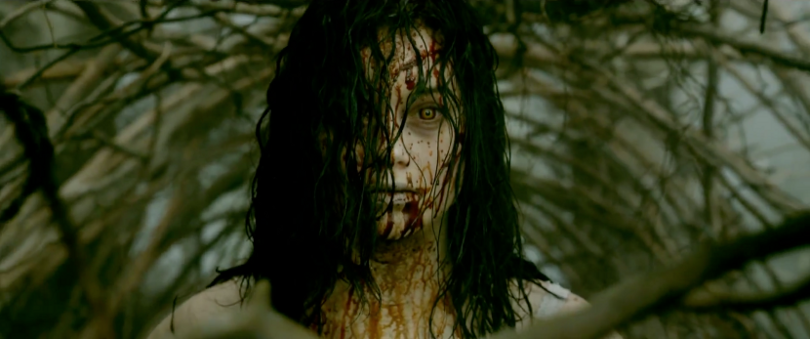
Right off the bat, Evil Dead is aware of its audience. Though newcomers are possible, and likely, writer and director Fede Alvarez was smart enough to assume that the majority of his viewers are the fans. Oh, those fans. Desperate for more of their favourite stuff, but "FUCK YOU" if it's not 100% perfect: removed but respectful, original but referential, the same but totally different. Alvarez approached this the way a smart person should: he did it the way he wanted to. If you're on board, cool. If not, you can hate him and keep your original. From the get go, he makes it clear this is a different approach. Where the original and most of its peers feature a group of horny teens looking for a getaway that'll afford them a weekend of drinking, smoking and fucking, Evil Dead's cast are heading to the cabin to get one of their friends off heroin. We're introduced to them and their personalities in a few slightly lengthy "Horror Movie Exposition Time" scenes, which are thankfully offset with a bunch of subtle nods to the original and hints at what electrical devices will be misused later on. Mia, the recovering addict, complains of a sick smell inside the house. It's only when the dog (why does there have to be a dog?) scratches at the rug covering the basement hatch that the Scooby Gang decide to investigate. Downstairs, there hangs a truly ridiculous amount of skinned cats (perhaps the pound thought they were going to a good home?), a burnt post covered in dried blood and a book made of human skin, bound shut by barbed wire. In spite of the warnings that literally say "Don't fucking read this fucking book, you fucking moron", one of the Scooby Gang reads the book ("Uhh, he's an English teacher", is the movie's excuse), the spiritual power of something from Hell (there's one word in the book that not so subtly hints at what) is unleashed and possesses the group one by one to set in motion a series of violent rituals that will initiate its material manifestation.


I'm going to get the bad out of the way first. If it sounds like I'm being facetious, I am. Kind of. The movie seems consistently unsure of what it wants to be, thematically speaking. Though the initial premise is certainly an approach largely unseen in movies of this nature, Alvarez seems reluctant to do anything worthwhile with it. Mia's claims that something supernatural is with them is dismissed early on as side effects of her withdrawals, and you do start to entertain the notion that her struggle against the evil will be offset with her struggle against heroin, but eventually, everyone just behaves like horror movie characters and her addiction is all but forgotten. Though their incompetence is occasionally the set-up for a punchline from the film's comic relief ("Everything's gonna be fine? Nothing's fine. I don't know if you noticed this, but everything's been getting worse every second"), it's very by the numbers. Which is fine, it's intentionally operating within the vein of the horror films that came before it, but it begs the question why bother spending so much time establishing that original premise if it's just going to be abandoned?

Having said that, here's the other thing: Mia's story makes us care about her. Even though it's superficially delivered, with barely serviceable acting, her struggle with addiction coupled with the estrangement she shares with her brother regarding their recently passed mother deals with themes we can identify and cannot help but sympathise with. Which can make for some gut-wrenchingly effective horror, if the overall goal of your horror movie isn't to deliver over-the-top, sensationalist violence to characters you're not really supposed to care about; if the overall goal of your horror movie isn't to be Evil Dead. So hot on the heels of a scene in which a possessed, one-armed woman with a face full of nails has her other arm blown up by a sawn-off shotgun in an explosion of red goop is a scene in which a brother can't set his possessed sister on fire because she starts reciting the lullaby their mother sang to them before she died. It's just cruel, and it tarnishes the fun of the rest of the movie.


But holy shit, is the rest of the movie fun. And violent. Holy shit, is this movie violent. I mentioned earlier how impressive The Evil Dead was technically speaking. For a movie so obviously made by a bunch of twenty-something amateurs fresh out of college, it's got some fuck off good camera work and special effects. It makes you feel like you could do this yourself. While Evil Dead is obviously miles ahead of its predecessor visually speaking, and Alvarez is a more competent director than Raimi was at that time, he's approached the overall production with a similar attitude, namely by making the movie without the use of CGI. Everything you see in this movie was achieved through prosthetics, props and simple movie magic (they're called illusions, Michael). I can't stress the importance and impressiveness of that enough. Having effects that are achieved practically leads to camera shots that force you to look at them; a stark contrast to cutting away or shaking the camera as a cheap diversion tactic. Combine that with a director that knows how to frame a shot, and you've got a winning formula. Where other movies would cut away and squirt some red goop an animator threw together in five minutes once a character has revved up the chainsaw, Alvarez frames a beautiful wide shot and forces you to watch one character push the chainsaw through their victim face first while the rest of their body flails in the wind. I can think of only one occasion where the audience doesn't witness an act of violence, and even then, it's supplemented with another gorgeously framed shot. This is without a doubt the most violent movie I've seen in recent years, and definitely one of the most violent movies I've seen ever. If nothing else, Evil Dead can stand proudly beside Peter Jackson's Dead Alive. 70,000 gallons of fake blood was used in Evil Dead. 50,000 gallons of fake blood was used in the final act. It literally rains blood.

Watching this film, I was reminded a lot of Dario Argento's Deep Red. Stick with me, here. In Deep Red, Argento set up a series of murder set-pieces all based around pain that the audience could identify with. A character is killed by being thrown head-first onto various surface corners. Another is boiled alive. These are injuries we have experienced ourselves, magnified to extreme levels. Evil Dead employs a similar approach. Though the violence is extremely over-the-top, and characters withstand way more than any normal human being could, the tools with which the violence is inflicted hits quite close to home. Needles, electric knives, box cutters, glass, nails, teeth; all and more are used to devastating effect. Believe it or not, this makes it more fun to watch. We're faced with pain we know, jacked up to a psychotic level, so that we may laugh at it. A character cuts through her arm with an electric knife to stop the infection spreading through her hand. "I feel better now..." she says softly as the tendon she missed snaps, her arm falls to the floor with a wet slap and we laugh nervously with our friends and curl out of the foetal position.


Here's where Evil Dead truly succeeds though: it doesn't really care if you're a fan or not. Sure, the references to its predecessors are there: the "force" camera, the Oldsmobile, the tool shed, the boom stick, even a pictorial reference to our favourite pissed off hand is there if your eyes are sharp enough. But at its core, this is Fede Alvarez's film and he's out to subvert your expectations as much as possible. The Deadites return, but rather than chant "We're gonna get you, not another peep" in between bouts of maniacal laughter, they slice their tongue open with a box cutter and stick the two halves down a hapless victim's throat. The tree rape returns, but in a way that feels more, dare I say, personal. It carries a significant weight with it, and unlike the original, the victim doesn't magically forget what happened to her ("There was something in the woods, David, and I think it's in here...with us...now"). Perhaps the best example comes in the film's final act, that reminded me a lot of The Cabin in the Woods, but I'm not going to spoil it. I saw an interview with Fede Alvarez recently and he talked about David Cronenberg's approach to remaking The Fly. "I decided not to give a fuck about the original. That was the only way to honour it." Well said, and well done.